Collection Far Far Away
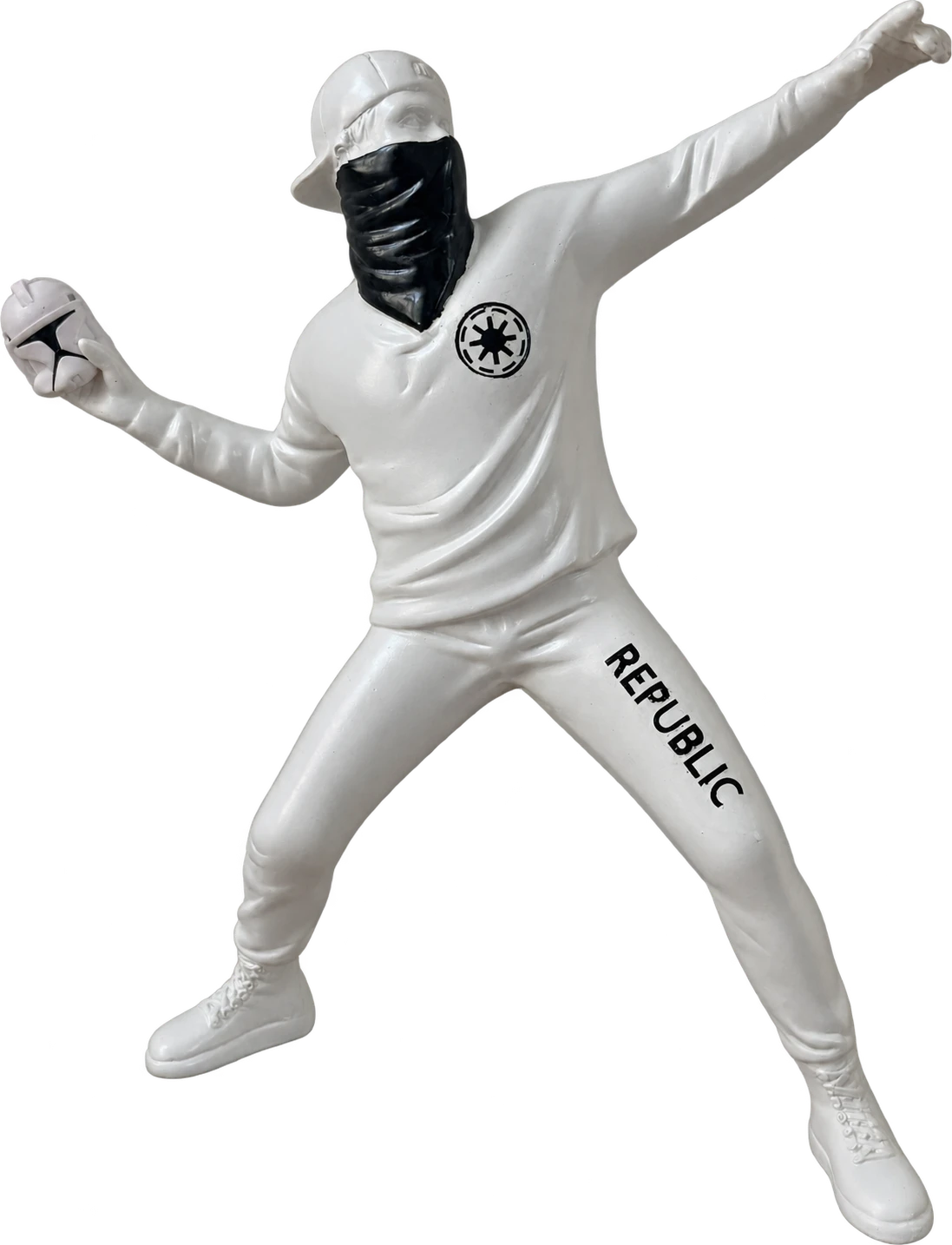
Shiny P1 Thrower revisits Banksy’s iconic Flower Thrower through the Star Wars universe, depicting a Phase I Clone Trooper of the Grand Army of the Republic.
Recognisable by his immaculate white armour, distinctive helmet and the Republic emblem on his chest, this soldier embodies the early days of the Clone Wars. The term Shiny, used for novice clones with perfectly clean armour, highlights his inexperience and the innocence that precedes combat.
Between street art and science fiction, this sculpture reimagines a soldier created to obey by giving him a rebel’s gesture.
A reflection on identity, free will and the humanity hidden behind thousands of identical faces. Because even when you are born to follow orders, you can dream of choosing your own path.
May the art be with you!
- Year
- 2026
- Edition
- 99 copies
- Dimensions
- H. 21,5 cm · L. 18 cm · P. 5,5 cm
The story behind the artwork
Behind the armour, a man
Kamino. An ocean-covered planet where the rain seems never to stop.
Behind the white walls of the cloning facilities, thousands of soldiers grow up far from the worlds they will one day be tasked with defending. They all have the same face. The same genetic heritage. The same supposed destiny.
They are the clones of the Republic. Created from Jango Fett’s genetic template, they were designed to become a disciplined, efficient army entirely devoted to its mission.
Among them, a young soldier puts on his Phase I armour for the first time. White. Immaculate. Without the slightest trace of battle. A Shiny. He has not yet known the dust of Geonosis, the violence of battle or the loss of his brothers. For now, war is only a collection of simulations and orders learned by heart.
But behind a helmet identical to thousands of others, there is already something unique. A personality. Emotions. A consciousness asking only to exist.
In Shiny P1 Thrower, the soldier adopts the stance of Banksy’s famous thrower. A gesture of rebellion for a being whose entire existence was conceived around obedience.
This paradox gives the work its meaning. His white armour represents the uniformity of a mass-produced army. The Republic symbol recalls the ideals he must serve. But his gesture seems to ask a question no one taught him to formulate: what if his destiny belonged to him? Because clones are not simply numbers or living weapons. They are individuals who learn, through combat, to become brothers, friends and sometimes men capable of disobeying.
Before the scars, before the battles, before the impossible choices, there was this perfectly white armour. A soldier still untouched. A story yet to be written. They were created identical. But none was destined to live exactly the same story.
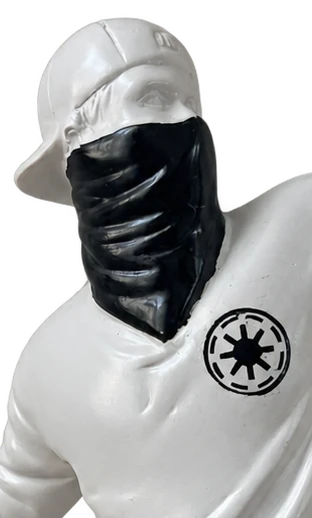
Photo gallery
Certificate of authenticity
Each artwork comes with its certificate of authenticity, numbered and signed by the artist.
Enquire about this artwork