Collection Sainte Trinité

Bata Thrower reinterprets Banksy’s iconic Flower Thrower through the dark and fascinating world of Batman.
The silhouette of Gotham’s famous vigilante adopts the thrower’s gesture, replacing the bouquet of flowers with his emblematic batarang. A weapon that has become a symbol of justice, resistance and the struggle against chaos.
Between street art and superhero mythology, this sculpture brings together two figures of rebellion: one exposes injustice through art, while the other fights it in the shadows.
When justice takes on the gesture of revolt, even darkness becomes a symbol of hope.
- Year
- 2026
- Edition
- 99 copies
- Dimensions
- H. 21,5 cm · L. 18 cm · P. 5,5 cm
The story behind the artwork
Justice is born in the shadows
Gotham City. A city where the shadows seem to have won long ago. In its streets, crime flourishes, fear rules and justice struggles to find its place.
But above the buildings, a silhouette keeps watch. He has no supernatural powers. No extraterrestrial origins. Only a will forged in tragedy and a promise to himself: never again let fear determine the fate of the innocent.
His name is Batman.
Having become the symbol of a city that refuses to fall, he turns his own pain into a weapon against injustice.
In Bata Thrower, the Dark Knight borrows the stance of Banksy’s famous thrower. The bouquet disappears, replaced by a batarang ready to cut through the darkness.
But this gesture tells much more than a story of confrontation. It embodies one man’s revolt against a world he refuses to accept. A silent resistance to violence, corruption and fate. Because Batman does more than seek to defeat his enemies. He wants to prove that a doomed city can still choose the light.
And behind the vigilante’s mask lies a universal truth: you do not need powers to change the world. Sometimes, all it takes is refusing to look away.
In a city ruled by fear, becoming a symbol is already an act of rebellion.
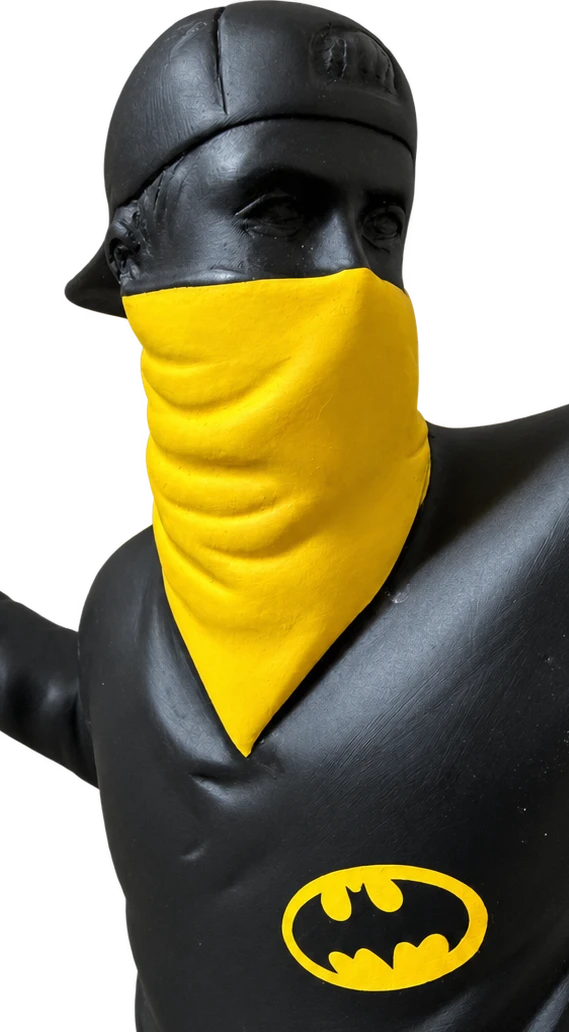
Photo gallery

Certificate of authenticity
Each artwork comes with its certificate of authenticity, numbered and signed by the artist.
Enquire about this artwork