Collection 7e Art
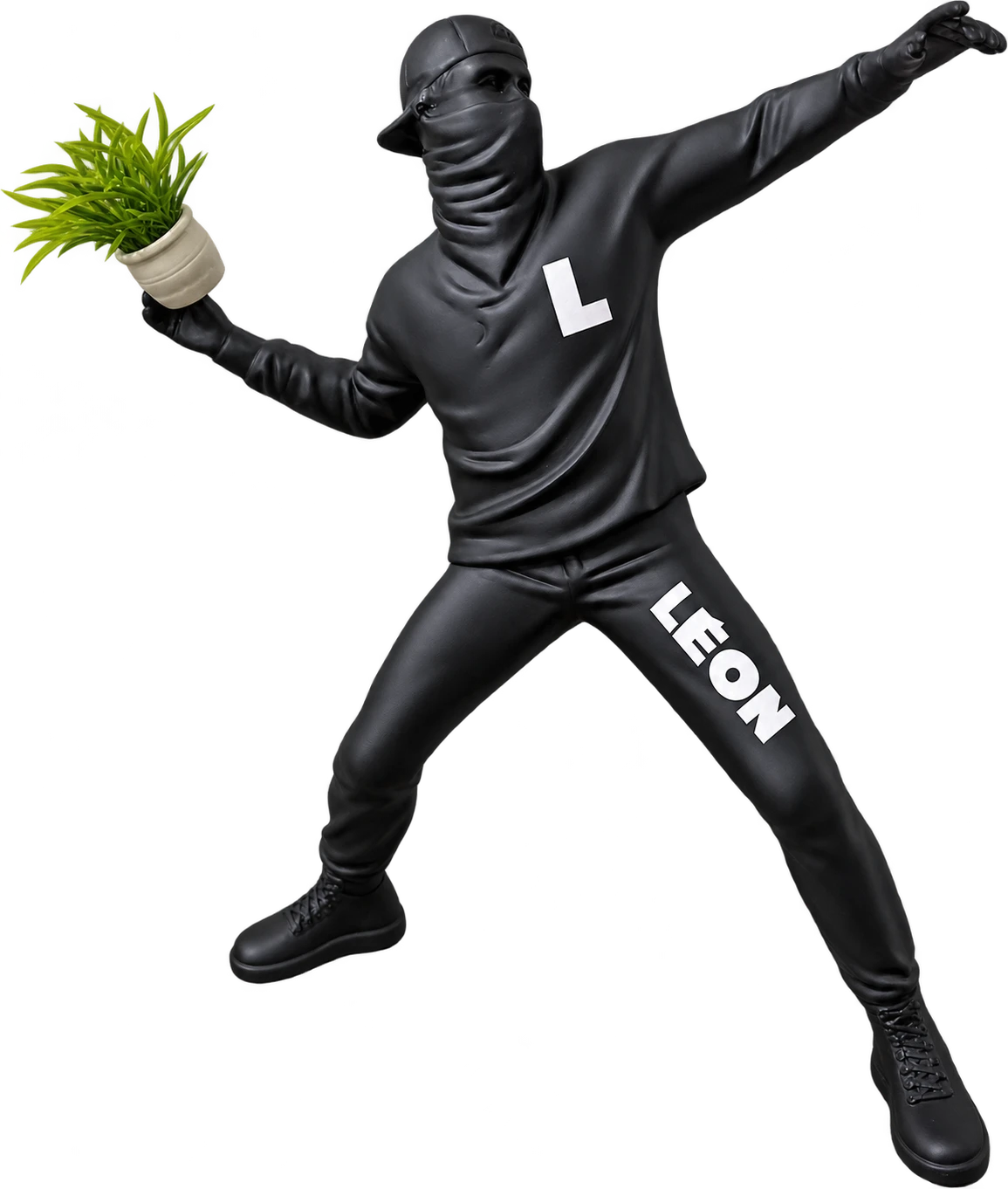
Plant Thrower reinterprets Banksy’s iconic Flower Thrower through the world of Luc Besson’s film Léon, placing one of cinema’s most symbolic objects at the heart of the work: Léon’s plant.
For this solitary hitman, the plant represents his only emotional attachment before meeting Mathilda. A living being he cares for, reflecting a humanity he hides behind his apparent coldness.
Between street art and cinema, this sculpture transforms the thrower’s gesture into a metaphor for solitude, protection and attachment. A poignant contrast between a man accustomed to taking lives and the fragile plant to which he devotes so much attention. Because even the most solitary beings sometimes need something to love.
- Year
- 2026
- Edition
- 99 copies
- Dimensions
- H. 21,5 cm · L. 18 cm · P. 5,5 cm
The story behind the artwork
Roots for those who have none
New York. An almost empty apartment. A few pieces of furniture, a window and a green plant placed near the light.
In this silent setting lives Léon. A solitary, discreet man whose existence is governed by unchanging habits. He drinks milk, sometimes watches old films and has a profession that leaves little room for feelings.
Léon is a hitman. But amid this life of violence and isolation, there is an exception. His plant. He cleans it, waters it and moves it so that it can enjoy the light. It is his only true companion, asking no questions and demanding nothing but a little attention. Like him, it seems to belong nowhere. Its roots are confined to a pot, condemned to follow its owner’s movements.
Then Mathilda enters his life. A child who overturns his certainties and helps him discover what he thought he had lost: the possibility of becoming attached to someone.
In Plant Thrower, Léon borrows the stance of Banksy’s famous thrower. But instead of a weapon, he holds this fragile plant, his most precious possession.
The gesture becomes a deeply moving paradox. A man whose profession is to take life is frozen in a movement where he seems to offer the world the only life he has always protected.
Violence meets tenderness. Solitude reveals the possibility of attachment. And the most ordinary object becomes the symbol of a hidden humanity. Because sometimes, what we protect reveals more about who we are than what we show others.
Léon had no roots. But he had a plant. And with Mathilda, he discovered that it was still possible to grow some.
Photo gallery

Certificate of authenticity
Each artwork comes with its certificate of authenticity, numbered and signed by the artist.
Enquire about this artwork