
Collection 7e Art

Hover Thrower propels Banksy’s iconic Flower Thrower into the world of Back to the Future.
Inspired by Marty McFly, this sculpture revisits the famous gesture of rebellion by replacing the bouquet with the emblematic hoverboard, a symbol of freedom and of a future once imagined.
Between street art and cult cinema, the codes of two generations meet. Banksy’s stance of protest encounters Marty McFly’s carefree spirit in a work where nostalgia becomes a movement towards the future.
If you are going to defy the rules, you might as well defy those of time.
- Year
- 2026
- Edition
- 99 copies
- Dimensions
- H. 21,5 cm · L. 18 cm · P. 5,5 cm
The story behind the artwork
The future will not wait
1985. A teenager steps into a DeLorean without imagining that his destiny will cross the ages. Marty McFly quickly discovers that time is not a straight line. A single gesture can alter the past, transform the present and rewrite the future.
In 2015, he discovers a world of flying cars, futuristic trainers and skateboards that no longer touch the ground. Among these inventions is a pink board that became legendary: the hoverboard.
But in Hover Thrower, Marty is no longer trying to escape his pursuers. He is about to launch this symbol of an imagined future in a stance borrowed from Banksy’s famous Flower Thrower.
A gesture suspended between two eras. On one side, the rebellion of street art. On the other, the carefree spirit of a generation that believed anything was possible. The hoverboard becomes much more than a cult object. It embodies yesterday’s dreams, tomorrow’s promises and the universal desire to break free of limits. Because while the past shapes us, it should never decide our future.
After all, where we are going, we do not need roads.
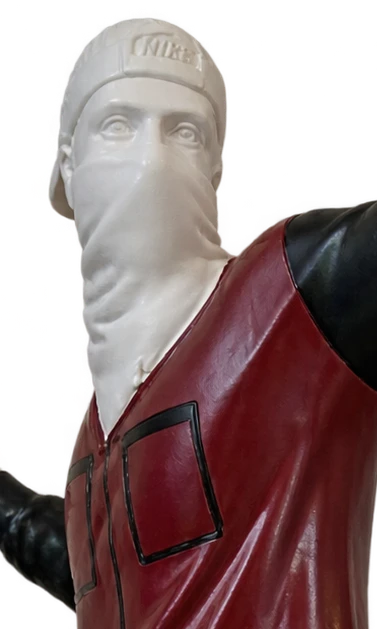
Photo gallery
Certificate of authenticity
Each artwork comes with its certificate of authenticity, numbered and signed by the artist.
Enquire about this artwork