
Collection Champions - France

98 Thrower revisits Banksy’s iconic Flower Thrower through one of the greatest moments in French football history: the 1998 World Cup.
Dressed in the legendary blue France shirt worn by Zinédine Zidane during the tournament, the thrower’s silhouette becomes the symbol of a generation and a victory etched into collective memory.
Between street art and football legend, this sculpture transforms a gesture of revolt into a tribute to achievement, pride and the emotion of a nation united by the same dream.
One shirt. One star. An eternity.
- Year
- 2026
- Edition
- 99 copies
- Dimensions
- H. 21,5 cm · L. 18 cm · P. 5,5 cm
The story behind the artwork
The night France reached the stars
12 July 1998. Stade de France, Saint-Denis.
That evening, time seems suspended. Millions of eyes turn towards a pitch where eleven men are about to write a page of history. Facing Brazil, the reigning world champions, France dreams of winning football’s most prestigious trophy for the first time.
Then comes the 27th minute. A corner, a header from Zinédine Zidane, and an entire country holds its breath before erupting with joy. Moments before half-time, number 10 does it again. A second header. A second goal. A legend is being born. At the final whistle, the score leaves no doubt: 3–0. France are world champions.
In 98 Thrower, Banksy’s famous thrower leaves his anonymity behind to wear the blue of a generation. His stance, usually associated with protest, becomes that of a nation casting its joy, pride and dreams towards the sky. The national shirt is no longer simply sportswear. It bears witness to a moment when differences disappear behind a shared emotion.
An era. A number 10. A first star. Because some achievements do more than mark history. They become part of our identity. And since that July night, blue has never been quite the same colour.
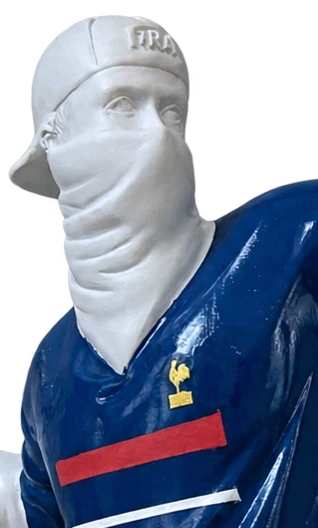
Photo gallery

Certificate of authenticity
Each artwork comes with its certificate of authenticity, numbered and signed by the artist.
Enquire about this artwork